Matter and Energy Cycling
In 2017, CSIRO soil scientists tracked carbon atoms through a eucalyptus forest and found the same atoms cycling between trees, soil microbes and the atmosphere over a period of 300 years.
Printable Worksheets
Print or save as PDF, or build a custom worksheet from any module's questions.
Q1 · Q1: When a tree dies and rots, where does the “stuff” of the tree go?
Q2 · Q2: Why does a compost heap get warm?
● Know
- matter is recycled through ecosystems
- the carbon cycle and water cycle move matter continuously
- decomposers break down dead matter and release nutrients
● Understand
- matter does not disappear; it changes form and location
- the carbon cycle includes plants, animals, soil and oceans
- fire returns nutrients to soil through ash
● Can do
- trace the carbon cycle using Australian examples
- explain how decomposers recycle matter
- evaluate claims about solving climate change using evidence
Nothing in a natural ecosystem is wasted. The same atoms pass through plants, animals, air, water and soil over and over again.
When a living thing dies, its matter does not vanish. Decomposers such as fungi and bacteria break down the dead material. They release nutrients back into the soil, where plants can absorb them again. This means the atoms that make up a tree today might once have been part of a kangaroo, a fern, or even a dinosaur.
Energy flows through ecosystems in one direction, mostly from the Sun. But matter is different. It cycles. The carbon in your lunch was once carbon dioxide in the air. The nitrogen in your muscles was once in the soil. This cycling is what keeps ecosystems running.
Draw or trace the carbon cycle using the following Australian organisms and places: a eucalypt, a koala, decomposers in the soil, and the atmosphere. Label each arrow with the process that moves the carbon (photosynthesis, feeding, respiration, decomposition).
The carbon cycle and water cycle are two of the most important ways matter moves through ecosystems, and both happen all around you.
Carbon cycle: Plants take in carbon dioxide from the atmosphere during photosynthesis and use it to build sugars and tissues. When animals eat plants, the carbon moves into the animal. When the animal breathes out, it releases carbon dioxide back into the atmosphere. When plants or animals die, decomposers break them down and carbon returns to the soil. Some carbon is also stored in oceans and rocks.
Water cycle: Water evaporates from oceans, rivers and dams. It also leaves plants through transpiration, which is like plant sweating. The water vapour rises, cools and condenses into clouds. When the droplets become heavy enough, they fall as rain or other precipitation. The cycle then starts again. This happens continuously, not just on rainy days.
In the water cycle, water [blank] from oceans and rivers, [blank] into clouds, and falls as [blank]. Plants also release water through [blank].
Australian ecosystems have adapted to fire, and nutrient cycling helps explain how bushland recovers after a burn.
After a bushfire, the ash that remains is rich in nutrients such as potassium, calcium and phosphorus. These nutrients were locked inside plant material before the fire. The fire releases them quickly into the topsoil. This is why some native plants, such as Acacia species, germinate rapidly after fire. The nutrient pulse gives the new seedlings a head start.
However, if the fire is too intense or too frequent, the nutrients can be washed away by rain before plants can use them. This is one reason scientists monitor fire intervals so closely in national parks. The cycle works best when there is enough time for soil, decomposers and plants to rebuild between burns.
A student says: “If we plant more trees, we can solve climate change on our own.” Use the Claim-Evidence-Reasoning frame below to evaluate this statement.
Claim-Evidence-Reasoning Frame
Claim: State whether you agree, disagree or partly agree.
Evidence: Use facts from the lesson about the carbon cycle and other sources of carbon dioxide.
Reasoning: Explain how the evidence supports your claim.
Wrong: “Matter disappears when something dies.”
Right: Decomposers break down dead matter and recycle it into soil, air and water. The atoms are reused by plants and enter the food chain again.
Wrong: “The carbon cycle is only about CO 2 .”
Right: The carbon cycle includes carbon in plants, animals, soil, oceans and rocks. Carbon dioxide is just one form carbon takes.
Wrong: The water cycle only happens when it rains, the rest of the time water just sits where it is.
Right: Evaporation, transpiration and condensation happen continuously. Rain is just the most visible part.
Wrong: Bushfires destroy everything in an ecosystem and leave the soil completely barren and useless.
Right: Ash returns nutrients to the soil. Fire releases them quickly, which can actually help new plants grow if the soil stays in place.
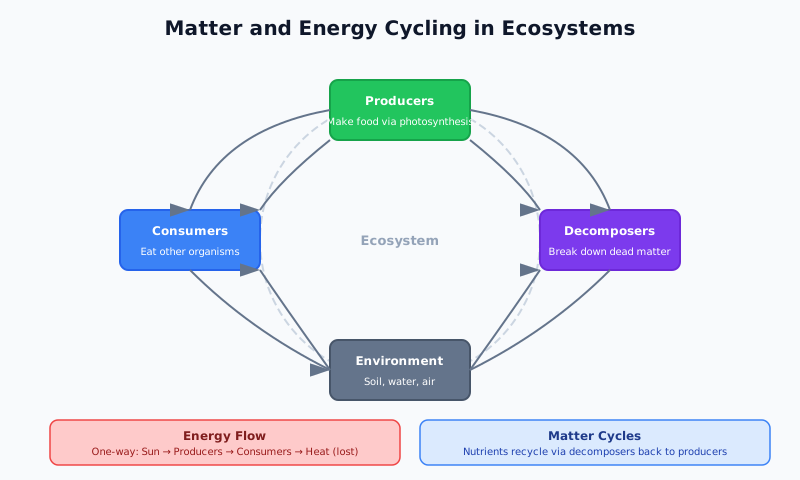
Diagram 2: The Water Cycle at a Local Scale
Illustration showing evaporation from a creek, transpiration from eucalypts, condensation into clouds, and precipitation over a catchment. Include labels for each stage and show that the cycle runs continuously.
Today's hook reminded you that the carbon atoms in your body were once part of a dinosaur, matter never disappears, it just cycles. And your backyard compost heap getting warm is actually proof of this cycling happening right now.
Now that you've worked through the lesson, can you answer fully: when a tree dies and rots, where does the “stuff” of the tree go? Name the decomposers involved, what they release, and where those released materials end up next in the cycle.
Q1. Explain what happens to the matter in a fallen eucalypt log over time.
1 mark for mentioning decomposers, 1 mark for explaining nutrient release, 1 mark for stating reuse by plants.Q2. Describe how the carbon cycle involves plants, animals, soil and the atmosphere.
1 mark for each component correctly linked to the carbon cycle, 1 mark for showing connections between them.Q3. Explain why a compost heap gets warm, using the terms decomposer and nutrient cycle .
2 marks for explaining decomposer activity and heat release, 2 marks for linking this to the nutrient cycle, 1 mark for a concrete example.Model answers (click to reveal)
Model Answers
+Multiple Choice
1: C. Decomposers break down dead matter and recycle it into the ecosystem. Matter does not disappear.
2: B. Plants remove carbon dioxide from the atmosphere during photosynthesis and use it to build tissues.
3: A. Decomposers release heat as they break down organic matter in the compost.
4: D. Ash returns nutrients to the soil, which helps new plants grow after a fire.
5: B. Energy flows one way through an ecosystem, but matter is recycled continuously.
Short Answer 1 (3 marks)
Sample answer: Decomposers such as fungi and bacteria break down the wood (1 mark). They release nutrients such as nitrogen and carbon back into the soil (1 mark). These nutrients are then absorbed by new plants and reused in the ecosystem (1 mark).
Short Answer 2 (4 marks)
Sample answer: Plants absorb carbon dioxide from the atmosphere during photosynthesis (1 mark). Animals eat plants and take in the carbon (1 mark). When animals breathe out, they release carbon dioxide back into the atmosphere (1 mark). When plants and animals die, decomposers break them down and carbon returns to the soil, completing the cycle (1 mark).
Short Answer 3 (5 marks)
Sample answer: A compost heap gets warm because decomposers such as bacteria and fungi are breaking down the organic matter (1 mark). This activity releases heat as a by-product (1 mark). As the decomposers break down the waste, they release nutrients into the compost (1 mark). These nutrients re-enter the nutrient cycle when the compost is added to soil and absorbed by plants (1 mark). For example, a school compost bin heats up because millions of decomposers are recycling banana peels and leaves into nutrient-rich humus (1 mark).
Revisit Your Thinking
Look back at what you wrote in the Think First section. How has your understanding changed about where the “stuff” of a dead tree goes, and why compost gets warm?
Model answers (click to reveal)
Model Answers
+Multiple Choice
1: C. Decomposers break down dead matter and recycle it into the ecosystem. Matter does not disappear.
2: B. Plants remove carbon dioxide from the atmosphere during photosynthesis and use it to build tissues.
3: A. Decomposers release heat as they break down organic matter in the compost.
4: D. Ash returns nutrients to the soil, which helps new plants grow after a fire.
5: B. Energy flows one way through an ecosystem, but matter is recycled continuously.
Short Answer 1 (3 marks)
Sample answer: Decomposers such as fungi and bacteria break down the wood (1 mark). They release nutrients such as nitrogen and carbon back into the soil (1 mark). These nutrients are then absorbed by new plants and reused in the ecosystem (1 mark).
Short Answer 2 (4 marks)
Sample answer: Plants absorb carbon dioxide from the atmosphere during photosynthesis (1 mark). Animals eat plants and take in the carbon (1 mark). When animals breathe out, they release carbon dioxide back into the atmosphere (1 mark). When plants and animals die, decomposers break them down and carbon returns to the soil, completing the cycle (1 mark).
Short Answer 3 (5 marks)
Sample answer: A compost heap gets warm because decomposers such as bacteria and fungi are breaking down the organic matter (1 mark). This activity releases heat as a by-product (1 mark). As the decomposers break down the waste, they release nutrients into the compost (1 mark). These nutrients re-enter the nutrient cycle when the compost is added to soil and absorbed by plants (1 mark). For example, a school compost bin heats up because millions of decomposers are recycling banana peels and leaves into nutrient-rich humus (1 mark).
● Big Idea
Matter is recycled through ecosystems by decomposers and natural cycles.
● Key Cycles
The carbon cycle and water cycle move matter continuously through living and non-living parts.
● Why It Matters
Bushfire recovery, composting and healthy soil all depend on efficient nutrient cycling.
● Bridge Forward
Next lesson explores how populations change when new species arrive in an ecosystem.