Gravimetric Analysis
A gold mining company needs to know how much gold is in a tonne of ore — not approximately, exactly. A water treatment plant needs to measure sulfate contamination down to 0.1 mg. Both use gravimetric analysis: the oldest quantitative technique in chemistry, and still one of the most accurate. The principle is beautifully simple — cause precipitation, filter, dry, weigh.
Download this lesson's worksheet
Use the PDF for classwork, homework or revision. It includes key ideas, activities, questions, an extend task and success-criteria proof.
A chemist wants to find the mass of sulfate ions (SO₄²⁻) dissolved in a water sample — but sulfate ions are invisible in solution and can't be weighed directly. What strategy might they use to convert the invisible dissolved ions into something solid that can be weighed? What would they need to add to the water?
Type your initial thoughts below:
Record your ideas in your workbook.
Gravimetric Calculation Pathway
Know
- Definition of gravimetric analysis
- What a precipitate is and why it forms
- The 5-step experimental procedure
- Examples: BaSO₄, AgCl, CaCO₃
Understand
- Why the precipitate must be insoluble
- Why excess reagent is added deliberately
- How mole ratio links precipitate to analyte
Can Do
- Describe the gravimetric procedure with justifications
- Use precipitate mass to find analyte amount or concentration
- Apply mole ratios from balanced equations correctly
📚 Core Content
Misconceptions to Fix
Wrong: The mole is a measure of mass.
Right: The mole is a measure of amount of substance; one mole contains Avogadro's number of particles.
What Is Gravimetric Analysis?
Gravimetric analysis is a quantitative technique that determines the amount of an analyte (the substance being measured) by converting it into a pure, insoluble precipitate, then measuring the mass of that precipitate.
The key insight: if you know the mass of precipitate and the chemical formula of the precipitate, you can calculate exactly how many moles were formed — and from the balanced equation, work out how many moles of the original analyte were present.
BaSO₄ (barium sulfate) — used to measure sulfate (SO₄²⁻) concentration
AgCl (silver chloride) — used to measure chloride (Cl⁻) concentration
CaCO₃ (calcium carbonate) — used in some carbonate determinations
All are white, extremely insoluble solids — ideal for filtering and weighing.
Why Must the Precipitate Be Insoluble?
If the precipitate dissolves even slightly, some of the analyte stays in solution and is never collected on the filter. This means the mass you weigh underestimates the true amount — your result will be too low. The more insoluble the precipitate, the more complete the reaction and the more accurate the result.
Why Add Excess Precipitating Reagent?
Adding a slight excess of the precipitating reagent (e.g. excess BaCl₂ when precipitating SO₄²⁻) drives the reaction to completion — ensuring all of the analyte has been converted to precipitate. The excess reagent remains dissolved in solution and is washed away during filtration.
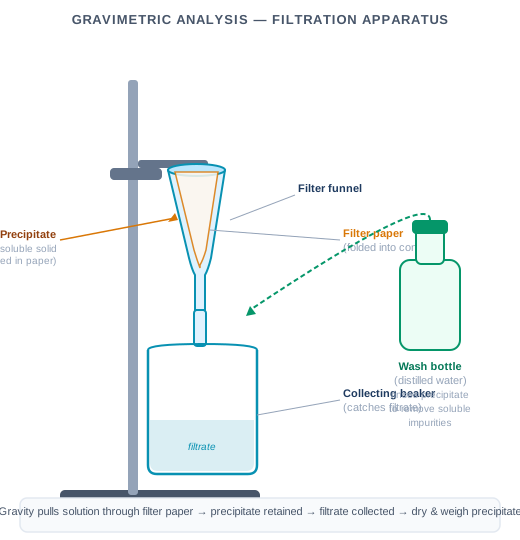
The Gravimetric Procedure — Step by Step
The Calculation Pathway
Once you have the mass of precipitate, the calculation follows a chain of three conversions:
Gravimetric vs Volumetric Analysis
| Feature | Gravimetric | Volumetric (Titration) |
|---|---|---|
| What is measured | Mass of precipitate | Volume of solution |
| Key equipment | Analytical balance, oven, filter | Burette, pipette, conical flask |
| Typical precision | Very high (±0.0001 g balance) | High (±0.05 mL burette) |
| Speed | Slow (hours — drying time) | Fast (minutes per titration) |
| Best for | Insoluble or sparingly soluble analytes | Acid-base, redox reactions |
🧮 Worked Examples
Worked Example 1 — Sulfate determination
Classic Gravimetric- 1Write the equation and identify mole ratioBa²⁺(aq) + SO₄²⁻(aq) → BaSO₄(s)Mole ratio: 1 mol BaSO₄ : 1 mol SO₄²⁻
- 2Calculate MM of BaSO₄ and find moles of precipitateMM(BaSO₄) = 137.33 + 32.06 + 4(15.999) = 233.39 g mol⁻¹n(BaSO₄) = 0.4660 ÷ 233.39 = 1.997 × 10⁻³ mol
- 3Apply mole ratio to find n(SO₄²⁻)n(SO₄²⁻) = n(BaSO₄) × (1/1) = 1.997 × 10⁻³ mol
- 4Calculate concentrationV = 250 mL = 0.250 Lc(SO₄²⁻) = 1.997 × 10⁻³ ÷ 0.250 = 7.99 × 10⁻³ mol L⁻¹
Worked Example 2 — Chloride determination with non-1:1 ratio awareness
Stepwise- 1Equation and mole ratioAg⁺(aq) + Cl⁻(aq) → AgCl(s)1 : 1 ratio — 1 mol AgCl produced per 1 mol Cl⁻
- 2Moles of AgClMM(AgCl) = 107.87 + 35.453 = 143.32 g mol⁻¹n(AgCl) = 1.435 ÷ 143.32 = 1.001 × 10⁻² mol
- 3(a) Mass of Cl⁻n(Cl⁻) = 1.001 × 10⁻² molm(Cl⁻) = n × MM = 1.001 × 10⁻² × 35.453 = 0.3549 g = 354.9 mg
- 4(b) Concentration in mg L⁻¹c = 354.9 mg ÷ 0.500 L = 709.8 mg L⁻¹ ≈ 710 mg L⁻¹
Common Mistakes
📓 Copy Into Your Books
▼📖 Definition & Procedure
- Gravimetric analysis: quantitative analysis by mass of a precipitate
- 1. Dissolve sample 2. Add excess precipitant 3. Filter 4. Dry 5. Weigh
- Must use insoluble precipitate for complete reaction
- Dry in oven, cool in desiccator before weighing
🧮 Calculation Chain
- m(precipitate) → ÷ MM → n(precipitate)
- n(precipitate) → × mole ratio → n(analyte)
- n(analyte) → × MM → m(analyte)
- n(analyte) → ÷ V → c(analyte)
⚗️ Common Precipitates
- BaSO₄ — measures SO₄²⁻
- AgCl — measures Cl⁻
- Both have 1:1 mole ratio with analyte
- Both extremely insoluble — nearly complete precipitation
⚠️ Key Reminders
- Use MM of precipitate (not analyte) for first step
- Always write the balanced equation
- Subtract filter paper mass before calculating
- Excess reagent → drives reaction to completion
🧪 Activities
Gravimetric Calculations
1 A 0.2332 g precipitate of BaSO₄ is obtained from a water sample. Calculate the moles of SO₄²⁻ in the sample. (MM of BaSO₄ = 233.39 g mol⁻¹)
Equation: Ba²⁺ + SO₄²⁻ → BaSO₄ (1:1 ratio)n(BaSO₄) = 0.2332 ÷ 233.39 = 9.99 × 10⁻⁴ moln(SO₄²⁻) = 9.99 × 10⁻⁴ mol (1:1 ratio)2 A 100 mL seawater sample produces 0.5735 g of AgCl precipitate. Calculate the concentration of Cl⁻ in mol L⁻¹. (Ag = 107.87, Cl = 35.453)
MM(AgCl) = 143.32 g mol⁻¹n(AgCl) = 0.5735 ÷ 143.32 = 4.001 × 10⁻³ mol = n(Cl⁻)c(Cl⁻) = 4.001 × 10⁻³ ÷ 0.100 = 0.0400 mol L⁻¹3 The filter paper used in a gravimetric experiment had a mass of 1.2455 g. After drying, the filter paper plus precipitate weighed 1.6823 g. What is the mass of the precipitate?
m(precipitate) = 1.6823 − 1.2455 = 0.4368 g4 A 200 mL sample of industrial wastewater is analysed and found to contain 0.6798 g of BaSO₄ precipitate. Calculate the concentration of SO₄²⁻ in the sample in g L⁻¹. (MM of BaSO₄ = 233.39, S = 32.06, O = 15.999)
n(BaSO₄) = 0.6798 ÷ 233.39 = 2.912 × 10⁻³ mol = n(SO₄²⁻)MM(SO₄²⁻) = 32.06 + 4(15.999) = 96.06 g mol⁻¹m(SO₄²⁻) = 2.912 × 10⁻³ × 96.06 = 0.2798 gc = 0.2798 ÷ 0.200 = 1.40 g L⁻¹
Type your working here:
Complete in your workbook.
At the start of this lesson, you thought about how to convert invisible dissolved sulfate ions into something solid that can be weighed.
The answer: add barium chloride (BaCl₂) solution — it reacts with SO₄²⁻ to form insoluble barium sulfate (BaSO₄): Ba²⁺ + SO₄²⁻ → BaSO₄(s). The precipitate can then be filtered, dried, and weighed. By measuring the mass of BaSO₄, you can calculate the moles of SO₄²⁻ using n = m ÷ MM, and then the concentration. This is the core principle of gravimetric analysis.
Reflect: how close was your strategy to the actual gravimetric method?
Write a reflection in your workbook.
Multiple Choice
5 random questions from a replayable lesson bank — feedback shown immediately
✍️ Short Answer
Extended Questions
6. A student performs a gravimetric analysis of a 250 mL sample of water to determine its sulfate content. After adding excess BaCl₂ and collecting the precipitate, the filter paper weighed 1.1234 g before and 1.5566 g after drying. Calculate: (a) the mass of BaSO₄ precipitate, (b) the moles of SO₄²⁻ in the sample, and (c) the concentration of SO₄²⁻ in mol L⁻¹. (MM of BaSO₄ = 233.39 g mol⁻¹) 5 MARKS
Type your answer:
Answer in workbook.
7. Describe the gravimetric procedure a student would follow to determine the mass of chloride ions (Cl⁻) in a 500 mL sample of tap water, using silver nitrate (AgNO₃) as the precipitating reagent. In your answer, identify the precipitate formed, justify why excess AgNO₃ is used, and explain why the precipitate must be dried before weighing. 5 MARKS
Type your answer:
Answer in workbook.
8. A 1.000 g sample of a mixture containing both NaCl and KCl is dissolved in water. Excess AgNO₃ is added and 2.3145 g of AgCl precipitate is collected. Calculate the percentage by mass of NaCl in the mixture. (Na = 22.990, K = 39.098, Cl = 35.453, Ag = 107.87) 6 MARKS
Type your answer below:
Answer in your workbook.
9. A student performs a gravimetric determination of sulfate in a sample. They add BaCl₂ to the sample but do not filter immediately — they wait 24 hours before filtering. After filtering and drying, the precipitate mass is slightly higher than expected. A classmate says: "This is because some atmospheric CO₂ dissolved in the solution and formed BaCO₃, which also precipitated." Evaluate whether this explanation is plausible and suggest another possible explanation for the higher mass. 5 MARKS
Type your answer below:
Answer in your workbook.
10. Design a complete gravimetric procedure to determine the percentage by mass of iron (Fe) in an iron ore sample (assumed to contain Fe as Fe₂O₃ and inert silica). You have access to: an analytical balance, HCl solution, NH₃ solution, filter paper, oven, desiccator, and a muffle furnace. The Fe³⁺ ions can be precipitated as Fe(OH)₃ and then ignited to Fe₂O₃ for weighing. Include calculations showing how you would determine % Fe from the final mass of Fe₂O₃. (Fe = 55.845, O = 15.999; MM(Fe₂O₃) = 159.69 g mol⁻¹) 7 MARKS
Type your answer below:
Answer in your workbook.
✅ Comprehensive Answers
▼❓ Multiple Choice
1. C — Excess reagent drives the precipitation reaction to completion, ensuring all analyte forms precipitate.
2. B — The first step always uses the MM of the precipitate (BaSO₄ = 233.39) to convert mass to moles.
3. A — After oven drying, the hot precipitate would absorb water from air on the bench. The desiccator contains drying agent (e.g. silica gel) that removes atmospheric moisture.
4. D — MM(AgCl) = 143.32. n = 0.9576 ÷ 143.32 = 6.68 × 10⁻³ mol. 1:1 ratio → n(Cl⁻) = 6.68 × 10⁻³ mol.
5. B — The extremely low solubility (Ksp ≈ 1.1 × 10⁻¹⁰) ensures virtually all SO₄²⁻ precipitates — the reaction goes to completion, giving an accurate result.
📝 Short Answer Model Answers
Q6 (5 marks):
(a) m(BaSO₄) = 1.5566 − 1.1234 = 0.4332 g (b) n(BaSO₄) = 0.4332 ÷ 233.39 = 1.857 × 10⁻³ mol; n(SO₄²⁻) = 1.857 × 10⁻³ mol (1:1 ratio) (c) c(SO₄²⁻) = 1.857 × 10⁻³ ÷ 0.250 = 7.43 × 10⁻³ mol L⁻¹Q7 (5 marks): Add excess AgNO₃(aq) to the 500 mL tap water sample and stir. The precipitate formed is AgCl(s) — a white, insoluble solid — via: Ag⁺(aq) + Cl⁻(aq) → AgCl(s). Excess AgNO₃ is used to ensure all Cl⁻ ions react and are converted to precipitate, driving the reaction to completion. Filter the precipitate through a pre-weighed filter paper, washing with distilled water to remove soluble impurities. Dry the precipitate in an oven at ~100°C and cool in a desiccator. The precipitate must be completely dry before weighing because any remaining water would add mass to the measurement, causing the calculated Cl⁻ content to be overestimated. Weigh the dry precipitate and subtract the filter paper mass to get m(AgCl), then calculate: n(AgCl) = m ÷ 143.32; n(Cl⁻) = n(AgCl); m(Cl⁻) = n × 35.453.
❓ MC — Q6, Q7 & Q8
6. D — n(BaSO₄) = 0.6200 ÷ 233.39 = 2.657 × 10⁻³ mol. c(SO₄²⁻) = 2.657 × 10⁻³ ÷ 0.500 = 5.31 × 10⁻³ mol L⁻¹. Both students gave incorrect answers — the first used 1.00 L, the second still halved incorrectly. Option D is correct.
7. C — Weighing a warm object on a balance creates convection currents above the pan that reduce the apparent mass reading (buoyancy effect). This causes the measured mass to be lower than actual — so the calculated moles of BaSO₄ are lower, giving a lower calculated % Ba²⁺ (underestimate).
8. D — n(BaSO₄) = 1.1669 ÷ 233.39 = 0.004999 mol. n(Ba²⁺) = 0.004999 mol (1:1 ratio). m(Ba²⁺) = 0.004999 × 137.327 = 0.6866 g. % Ba = (0.6866 ÷ 1.312) × 100 = 52.3%.
📝 Short Answer — Q8, Q9 & Q10
Q8 (6 marks):
MM(AgCl) = 107.87 + 35.453 = 143.32 g mol⁻¹ [1] n(AgCl) = n(Cl⁻) = 2.3145 ÷ 143.32 = 0.016148 mol [1]Let x = mass of NaCl. Then (1.000 − x) = mass of KCl. [1]
n(Cl⁻) from NaCl = x ÷ 58.443; n(Cl⁻) from KCl = (1.000 − x) ÷ 74.551 [1]
x ÷ 58.443 + (1.000 − x) ÷ 74.551 = 0.016148 0.017110x + 0.013413(1.000 − x) = 0.016148 0.003697x = 0.002735 → x = 0.7398 g NaCl [1] % NaCl = (0.7398 ÷ 1.000) × 100 = 74.0% [1]Q9 (5 marks):
The CO₂ explanation is plausible [1]. In acidic or neutral solution, CO₂ would not react significantly with Ba²⁺ (BaCO₃ Ksp ≈ 5.1 × 10⁻⁹ — slightly soluble). However, if the solution became basic over time (e.g., due to evaporation of HCl), BaCO₃ could co-precipitate with BaSO₄ [1]. Another plausible explanation: over 24 hours, the BaSO₄ particles could adsorb impurities from solution onto their surface (adsorption), adding mass without extra SO₄²⁻ [1]. A third explanation: incomplete drying — water trapped in the precipitate mass is also a possibility if the drying was not repeated to constant mass [1]. Overall, the student should filter promptly and dry to constant mass to avoid these errors [1].
Q10 (7 marks) — Procedure:
Step 1: Weigh ~1 g of iron ore sample accurately on an analytical balance. Record mass (m₁) [1].
Step 2: Dissolve in excess dilute HCl, heating gently. Filter to remove insoluble silica. The filtrate contains Fe³⁺(aq) [1].
Step 3: Add dilute NH₃ solution dropwise until pH ≈ 9 to precipitate Fe(OH)₃(s): Fe³⁺ + 3OH⁻ → Fe(OH)₃(s) [1].
Step 4: Filter through a pre-weighed crucible. Ignite in muffle furnace at 800°C: 2Fe(OH)₃ → Fe₂O₃ + 3H₂O. Cool in desiccator and weigh. Repeat to constant mass [1].
Calculation: n(Fe₂O₃) = m(Fe₂O₃) ÷ 159.69 [1]. n(Fe) = 2 × n(Fe₂O₃) [1]. m(Fe) = n(Fe) × 55.845. % Fe = (m(Fe) ÷ m₁) × 100 [1].
Consolidation Game
Gravimetric Analysis
Mark lesson as complete
Tick when you've finished all activities and checked your answers.