T Cells and Cell-Mediated Immunity
On 5 June 1981, the US CDC's Morbidity and Mortality Weekly Report documented 5 cases of Pneumocystis carinii pneumonia in previously healthy gay men in Los Angeles, the first official report of what would become AIDS. By December 1981, 270 cases had been reported and 121 people had died. HIV specifically targets CD4+ T helper cells, reducing their count from a normal 500–1,500/mm³ to below 200/mm³ (the clinical threshold for AIDS), systematically dismantling the entire adaptive immune response.
Orient yourself
Warm up on earlier material, predict why losing one cell type collapses everything, then scan the goals and vocabulary.
Three quick questions from earlier lessons. Pulling old material back to mind before you learn something new makes the new material stick better, so this is not busywork.
Practise this lesson
Four printable worksheets that build from the foundations up to exam-style questions, start at whatever level suits you.
A person with untreated HIV eventually develops AIDS, a state in which the immune system can no longer defend against infections that a healthy person would clear without noticing. The defining feature of AIDS is a very low CD4+ T cell count.
Before reading: predict why losing CD4+ T cells specifically would collapse the immune system. What do you think CD4+ T cells do, and why might losing them affect both antibody production AND the ability to kill infected cells?
Know
- The two main types of T cells and their surface markers
- What cell-mediated immunity is and how it differs from humoral immunity
- How cytotoxic T cells identify and kill target cells
- The role of T helper cells in coordinating both arms of immunity
Understand
- Why MHC class I is essential for cytotoxic T cell targeting
- Why T helper cells are the central coordinators of adaptive immunity
- How HIV exploits the CD4 receptor to destroy the immune system
Can Do
- Distinguish humoral from cell-mediated immunity with examples
- Describe cytotoxic T cell activation and killing mechanism
- Explain why T helper cell loss collapses the entire adaptive immune response
Two arms, one system
Separate the humoral arm from the cell-mediated arm, then catch your own errors on a written passage.
Core Content
Humoral (B cells) vs cell-mediated (T cells)
By 1983, AIDS patients were dying from Pneumocystis pneumonia, cytomegalovirus retinitis, and Kaposi's sarcoma, infections that a healthy immune system clears routinely. Their antibody-producing B cells were still intact. Their cytotoxic T cells were still there. Yet the immune response was failing. The missing piece was the CD4+ T helper cell, the coordinator that both arms of adaptive immunity depend on to function.

Humoral immunity (L11) targets pathogens outside cells; cell-mediated immunity (this lesson) targets infected cells from within
Adaptive immunity has two arms. Humoral immunity: B cells → antibodies, targeting extracellular pathogens (covered in L11). Cell-mediated immunity: T cells targeting virus-infected host cells and cancer cells. Both are adaptive (specific, with memory) and triggered by antigen recognition; T cells also coordinate the whole adaptive response.
Pause, copy the humoral vs cell-mediated distinction into your book.
Cell-mediated immunity (T cells) mainly targets pathogens floating freely in the blood.
Cytotoxic T cells (CD8+) kill infected host cells by releasing perforin and granzymes, triggering apoptosis.
Helper T cells (CD4+) directly kill infected cells using the same mechanism as cytotoxic T cells.
Error Spotting, Cell-Mediated Immunity
Pattern B, Error Spotting
A student wrote the following explanation of cell-mediated immunity. The passage contains five factual errors. Identify each error, explain why it is wrong, and write the correct information.
- List the five errors in the passage.
- For each error, write one sentence explaining what is wrong and what the correct information is.
- Rewrite the passage as a corrected version in your own words.
CD4 versus CD8
Tell the two T cell types apart by marker, MHC class and job, the distinction the rest of the lesson rests on.
T helper (CD4+) and cytotoxic (CD8+)
We just saw that cell-mediated immunity is run by T cells. That raises a question: are all T cells the same? This card answers it → the two key types, helper (CD4+) and cytotoxic (CD8+), and how they differ.
All T cells mature in the thymus and are distinguished by surface CD markers, two types are central to the HSC course.
| Feature | T Helper Cells (CD4+) | Cytotoxic T Cells (CD8+) |
|---|---|---|
| Surface marker | CD4 protein | CD8 protein |
| Also called | T helper (Th), helper T cells | Cytotoxic T lymphocytes (CTLs), killer T cells |
| Activated by | Antigen on MHC class II (on dendritic cells and macrophages) | Antigen on MHC class I (on any nucleated body cell) + T helper signal |
| Primary function | Coordinate the entire immune response, activate B cells, cytotoxic T cells, and macrophages via cytokine secretion | Kill virus-infected cells, cancer cells, and cells displaying foreign antigens |
| Killing mechanism | Does not kill directly, acts via chemical signals (cytokines) | Perforin + granzymes → apoptosis of target cell |
| HIV target? | Yes, HIV uses CD4 as its entry receptor | No, HIV does not primarily target CD8+ cells |
T helper cells (CD4+): activated by antigen on MHC class II; coordinate the response via cytokines; do NOT kill directly. Cytotoxic T cells (CD8+): activated by antigen on MHC class I plus a T helper signal; kill infected cells using perforin + granzymes → apoptosis. Both produce memory T cells. HIV targets CD4+ cells via the CD4 receptor.
Pause, copy the CD4+ vs CD8+ table essentials (marker, MHC class, function) into your book.
T helper cells carry which surface marker, and are activated by antigen on which MHC class?
Killing with precision
Follow how a cytotoxic T cell finds exactly the right cell and destroys it without harming healthy neighbours.
The immune system's assassins, and how they recognise their targets
We just saw that cytotoxic T cells (CD8+) kill infected cells. That raises a question: how do they find the right cell and avoid killing healthy ones? This card answers it → the precise activation and killing sequence, step by step.
Cytotoxic T cells seek out and destroy specific infected cells, but only after a precise recognition process that needs both an antigen match and a T helper signal.
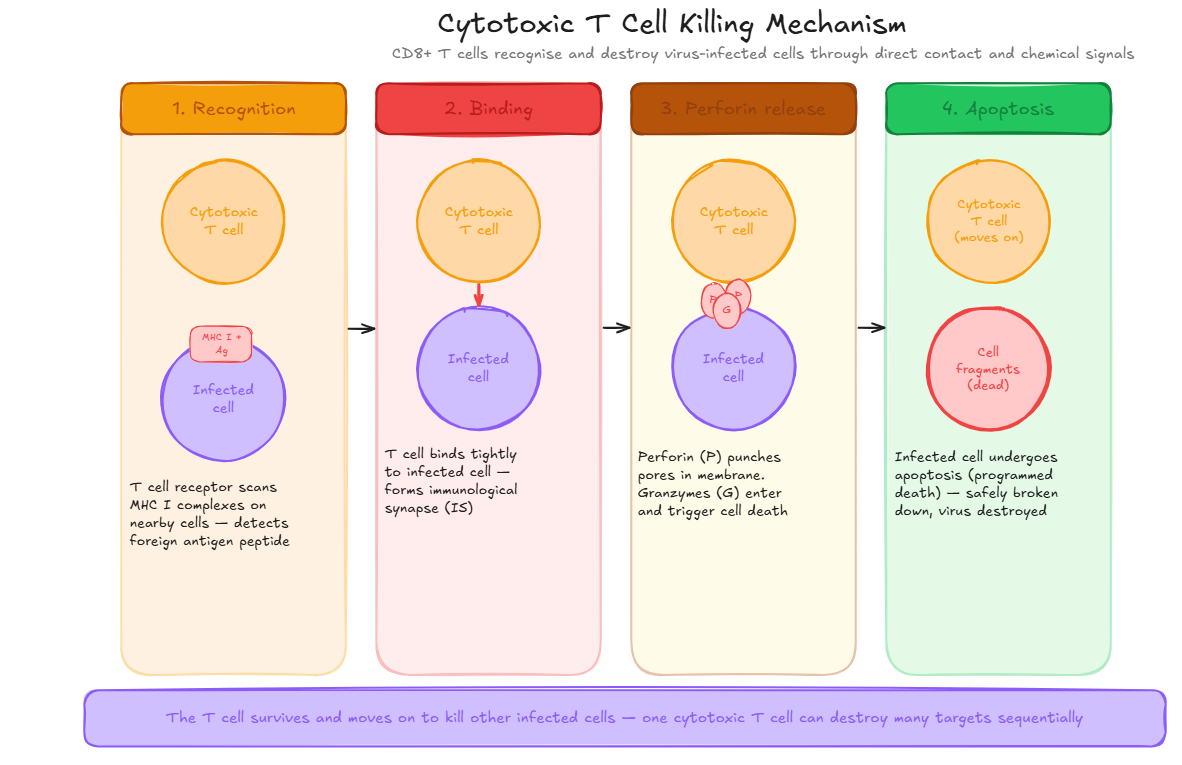
Cytotoxic T Cell Killing Mechanism

Cytotoxic T cell activation requires both antigen recognition (MHC I) AND a T helper signal, both must be present for killing to proceed
An infected cell displays viral peptide on MHC class I (present on all nucleated cells). The cytotoxic T cell recognises it (TCR binds) and, with a T helper IL-2 signal, undergoes clonal expansion. It kills via perforin (membrane pores) + granzymes (trigger apoptosis). Memory CTLs form. Only CTLs, not antibodies, can clear viruses hidden inside cells.
Pause, copy the CTL recognition (MHC I + T helper signal) and killing mechanism into your book.
Cytotoxic T cells kill infected cells using _____ (which punches holes in the membrane) and granzymes (which trigger apoptosis).
Losing the officers
See how much the T helper cell coordinates, then use HIV to explain what happens when it is removed.
The command centre of adaptive immunity
We just saw that cytotoxic T cells need a T helper signal to be activated. That raises a question: what exactly do T helper cells do across the whole immune system? This card answers it → the helper cell as the central coordinator of both immune arms.
T helper cells kill nothing directly, instead they are the command centre, and without their signals neither B cells nor cytotoxic T cells can mount a full response.

T helper cells coordinate both arms of adaptive immunity and bridge to innate responses, losing them collapses the whole system
T helper cells are activated when their T cell receptor (TCR) binds antigen displayed on MHC class II molecules, found only on antigen-presenting cells (dendritic cells, macrophages, and B cells). Once activated, they release cytokines that:
- Provide the co-stimulatory signal B cells need for full activation and antibody class switching
- Drive clonal expansion of cytotoxic T cells via interleukin-2 (IL-2)
- Enhance macrophage killing ability
- Recruit and activate NK cells, neutrophils, and eosinophils
T helper cells (CD4+) are activated by antigen on MHC class II (on antigen-presenting cells only). They release cytokines that activate B cells, cytotoxic T cells (via IL-2), macrophages, and innate cells, they coordinate the response but do not kill directly. This is why losing them (as in HIV) collapses BOTH the humoral and cell-mediated arms.
Pause, copy what T helper cells activate and why losing them collapses both arms into your book.
Why is the loss of CD4+ T helper cells (e.g. in HIV/AIDS) so damaging?
HIV (Human Immunodeficiency Virus) is a retrovirus with a precise entry mechanism: its envelope protein gp120 binds specifically to the CD4 receptor on T helper cells. This is not accidental, CD4 is the lock; gp120 is the key. Once inside the T helper cell, HIV integrates its genome into the host cell's DNA and uses the cell's own machinery to replicate. Over years of untreated infection, the CD4+ T cell count falls progressively, from a normal count of 500–1,500/mm³ to below 200/mm³, the threshold for AIDS diagnosis. As CD4+ T cells are destroyed, both arms of adaptive immunity lose their coordinator. B cells still exist but cannot receive the co-stimulatory signals needed for full activation, antibody responses become inadequate. Cytotoxic T cells cannot receive IL-2 and other activation signals, cell-mediated killing falters. The patient becomes vulnerable to "opportunistic infections", pathogens that a healthy immune system eliminates routinely: Pneumocystis pneumonia, toxoplasmosis, CMV retinitis, Cryptococcal meningitis. These are not unusual pathogens, they are everywhere. Without T helper cells, the body simply cannot respond to them. This is why HIV is so devastating: it does not need to attack every cell in the immune system. It just removes the coordinator, and the whole system falls apart. You will apply this in the practice questions.
T Cell Types
- T helper (CD4+): activated by MHC II; coordinates via cytokines; does NOT kill.
- Cytotoxic T (CD8+): activated by MHC I + T helper signal; kills infected cells.
- Both produce memory T cells after clonal expansion.
Cytotoxic T Cell Killing
- Recognises viral peptide on MHC class I.
- Requires T helper (IL-2) signal for full activation.
- Releases perforin → holes in target membrane.
- Releases granzymes → enter pores → trigger apoptosis.
T Helper Cell Functions
- Activates B cells (co-stimulatory signal for antibody production).
- Activates CTLs via IL-2 (drives clonal expansion).
- Enhances macrophage killing.
- Recruits innate cells (NK cells, neutrophils).
MHC Classes
- MHC I: all nucleated cells; presents intracellular peptides; recognised by CD8+ CTLs.
- MHC II: APCs only (dendritic cells, macrophages, B cells); presents extracellular antigens; recognised by CD4+ T helpers.

Cell-Mediated Immunity Pathway
Practise independently
Attempt at least one response in your own words. Model answers support checking; they do not replace the attempt.
A fresh set drawn from this lesson's question bank, feedback shown immediately. +5 XP per correct · +25 XP all correct
Pick your answer, then rate your confidence, that tells the system what to drill next.
UnderstandBand 3(3 marks) 1. Distinguish between the roles of T helper cells and cytotoxic T cells in the immune response. In your answer, identify the surface marker, activation signal (MHC class), and function of each cell type.
1 mark: T helper, CD4+, MHC II, coordinates via cytokines · 1 mark: CTL, CD8+, MHC I, kills via perforin/granzymes · 1 mark: explicit comparison (coordinator vs effector killer)
ApplyBand 4(3 marks) 2. Explain how a cytotoxic T cell destroys a virus-infected host cell. In your answer, describe how the infected cell is recognised and the mechanism by which it is killed.
1 mark: recognition, TCR binds viral peptide on MHC I · 1 mark: T helper (IL-2) signal required · 1 mark: killing mechanism, perforin + granzymes → apoptosis
EvaluateBand 5(4 marks) 3. Explain why HIV infection, which specifically destroys CD4+ T helper cells, eventually compromises both humoral and cell-mediated immunity. In your answer, refer to the specific roles of T helper cells in both arms of adaptive immunity.
1 mark: T helper role in humoral immunity · 1 mark: T helper role in cell-mediated immunity (IL-2 → CTL expansion) · 1 mark: both arms impaired simultaneously · 1 mark: clinical consequence (opportunistic infections)
Show all answers
Multiple choice
MC answers and full explanations are shown inline as you complete each question. Use the retry button to attempt a fresh set from the lesson bank.
Short Answer Model Answers
Q1 (3 marks): T helper cells carry the CD4 surface marker and are activated when their TCR binds antigen displayed on MHC class II molecules, found only on professional antigen-presenting cells (dendritic cells, macrophages, B cells). Their function is coordination: they release cytokines (IL-2, IL-4, interferon-gamma) that activate B cells, stimulate CTL clonal expansion, enhance macrophage killing, and recruit innate cells. They do not kill directly. Cytotoxic T cells (CTLs) carry the CD8 surface marker and are activated when their TCR binds viral or other foreign peptide displayed on MHC class I molecules, found on all nucleated body cells, combined with an IL-2 signal from a T helper cell. Their function is direct killing of infected cells: they release perforin (forms pores in the target membrane) and granzymes (enter through the pores and activate apoptosis). The core distinction is coordinator versus effector killer.
Q2 (3 marks): When a cell is infected by a virus, its machinery loads viral peptide fragments onto MHC class I molecules, displaying them on the cell surface. A cytotoxic T cell (CD8+) with a TCR matching that specific viral peptide-MHC class I complex binds the infected cell. This recognition alone is not sufficient, the CTL also requires an IL-2 signal from an activated T helper cell to fully activate and undergo clonal expansion. Once activated, the CTL kills its target by releasing perforin, which inserts into the target cell membrane and forms pores, and granzymes, proteases that enter through the pores and trigger the caspase cascade, causing apoptosis. The infected cell dies from within, halting viral production at the source.
Q3 (4 marks): T helper cells (CD4+) coordinate both arms of adaptive immunity. In humoral immunity, activated T helper cells provide the co-stimulatory signal (CD40L plus cytokines such as IL-4) required for full B cell activation, clonal expansion, and antibody class switching from IgM to high-affinity IgG, without it, B cells produce only weak IgM and poor memory. In cell-mediated immunity, T helper cells release IL-2 that drives clonal expansion of cytotoxic T cells, without IL-2, CTLs cannot proliferate into an effective killing force. HIV targets CD4+ T helper cells because viral gp120 binds the CD4 receptor; as the CD4+ count falls, both arms are simultaneously starved of coordination signals, antibody responses weaken and CTL responses weaken. The clinical consequence is susceptibility to opportunistic pathogens such as Pneumocystis jirovecii, Toxoplasma gondii, and Cryptococcus neoformans, organisms a healthy immune system clears routinely but that become life-threatening once T helper coordination is lost.
Retrieve and reflect
Use the Review session first, then compare how your thinking changed.
A full module quiz covering every lesson in this module, not just this one. Set aside a decent block of time and treat it like a real assessment.
Start the module quiz →Sprint through questions on T cells and cell-mediated immunity. Pool: lessons 1–12.
You were asked why losing CD4+ T cells specifically would collapse the whole immune system. The 5 June 1981 CDC MMWR report documented 5 cases of a new immunodeficiency syndrome. By the time HIV was identified as the cause in 1983, the pattern was clear: patients were dying from infections that normally pose no risk to healthy adults, because their CD4+ T helper cell counts had dropped from 500–1,500/mm³ to below 200/mm³. The virus had removed the one cell type that coordinates both antibody production (via B cell activation) and cell killing (via cytotoxic T cell expansion).
The answer: T helper cells are the coordinators of adaptive immunity, not the effectors. B cells require a T helper co-stimulatory signal to produce high-affinity IgG antibodies, without it, they generate only weak IgM responses. Cytotoxic T cells require IL-2 from T helper cells to undergo the clonal expansion needed to mount an effective killing response. Both arms depend on the same coordinator.
HIV is devastating not because it destroys a killer cell, it destroys the command structure. The killers (CTLs, NK cells) and the antibody producers (B cells) still exist, but without coordination signals they cannot respond effectively. It is the equivalent of an army losing all its officers, the soldiers are still there, but the response becomes disorganised and inadequate.
If you predicted that T helper cells activate other immune cells, you were exactly right. If you predicted that losing them would affect antibody production, also right. The insight that one cell type coordinates both arms simultaneously is the key.