Primary and Secondary Immune Response
On 14 May 1796, Edward Jenner vaccinated 8-year-old James Phipps with cowpox material taken from milkmaid Sarah Nelmes. Six weeks later, Jenner deliberately exposed Phipps to smallpox, no infection developed. Jenner published An Inquiry into the Causes and Effects of the Variolae Vaccinae in 1798; WHO declared smallpox eradicated on 8 May 1980, requiring 300 million vaccinations in the peak year of 1967 alone. The mechanism Jenner demonstrated without knowing it is the same one that underlies every vaccine ever made.
Orient yourself
Warm up on earlier material, predict what changed inside Phipps, then scan the goals and vocabulary.
Three quick questions from earlier lessons. Pulling old material back to mind before you learn something new makes the new material stick better, so this is not busywork.
Practise this lesson
Four printable worksheets that build from the foundations up to exam-style questions, start at whatever level suits you.
Edward Jenner's 1796 experiment: he took material from a cowpox pustule on a milkmaid's hand and scratched it into the arm of James Phipps, an 8-year-old boy. The boy developed mild cowpox symptoms, then recovered. Six weeks later, Jenner exposed the boy to smallpox, and nothing happened. The boy was protected.
Before reading: at the molecular and cellular level, why do you think the cowpox exposure protected James Phipps against smallpox? What was happening in his immune system during those six weeks?
Know
- What happens during the primary immune response
- What happens during the secondary immune response
- The role of memory cells in both B and T cell responses
- How vaccination exploits the primary response to generate protective memory
Understand
- Why the secondary response is faster and stronger
- Why some vaccines require boosters and others do not
- How herd immunity protects unvaccinated individuals
Can Do
- Interpret primary/secondary response graphs correctly
- Explain how vaccination mimics natural infection without causing disease
- Apply memory cell concepts to novel vaccination scenarios
The experiment that started it
Work out why cowpox protected against smallpox, and what that reveals about immune memory.
Core Content
How a milkmaid's cowpox launched modern immunology
On 14 May 1796, Edward Jenner scratched cowpox material from milkmaid Sarah Nelmes into the arm of 8-year-old James Phipps. Phipps developed a mild local reaction and recovered. Six weeks later, Jenner scratched smallpox material into his arm. Nothing happened. Phipps did not get smallpox. Jenner had no microscope, no knowledge of lymphocytes, and no understanding of why it worked, but he had documented the principle of vaccination in a single experiment.
1796, Edward Jenner and the Milkmaids
Jenner observed that dairy workers who contracted cowpox (a mild disease caused by vaccinia virus, related to but distinct from smallpox) appeared to be protected from smallpox, then one of the deadliest diseases in Europe. He tested this systematically by inoculating James Phipps with cowpox material, then challenging him with smallpox six weeks later. Phipps showed no symptoms. Jenner called his procedure "vaccination" from vacca (Latin: cow). He had no knowledge of B cells, T cells, or immunological memory, he simply demonstrated that prior exposure to a related mild pathogen conferred protection against a lethal one. His work preceded the germ theory of disease by nearly a century.
What Jenner discovered was that the immune system forms a memory after first exposure to an antigen. Cowpox and smallpox viruses share enough antigenic similarity that the memory B and T cells formed during cowpox infection also recognise smallpox antigens. When smallpox arrived, Phipps mounted an immediate secondary response, eliminating the virus before it caused disease.
In 1796 Edward Jenner inoculated James Phipps with cowpox and showed it protected him against smallpox. The mechanism (unknown to Jenner) is cross-reactive immune memory, cowpox and smallpox share antigens, so memory cells recognise both. "Vaccination" comes from vacca (Latin: cow). Smallpox was eradicated in 1980, the first human disease ever eradicated.
Pause, copy Jenner's experiment and the cross-reactive memory mechanism into your book.
Jenner's cowpox inoculation protected James Phipps against smallpox because:
First time versus every time after
Read the two response curves, then pin down exactly what memory changes: speed, size and antibody quality.
Speed, magnitude, and antibody quality, all explained by memory
We just saw that Jenner's protection came from immune memory. That raises a question: what actually changes between the first and second exposure to make memory so powerful? This card answers it → the primary vs secondary response, compared head to head.
The difference between the first encounter and every subsequent one, in speed, magnitude, and antibody quality, is entirely explained by immunological memory.
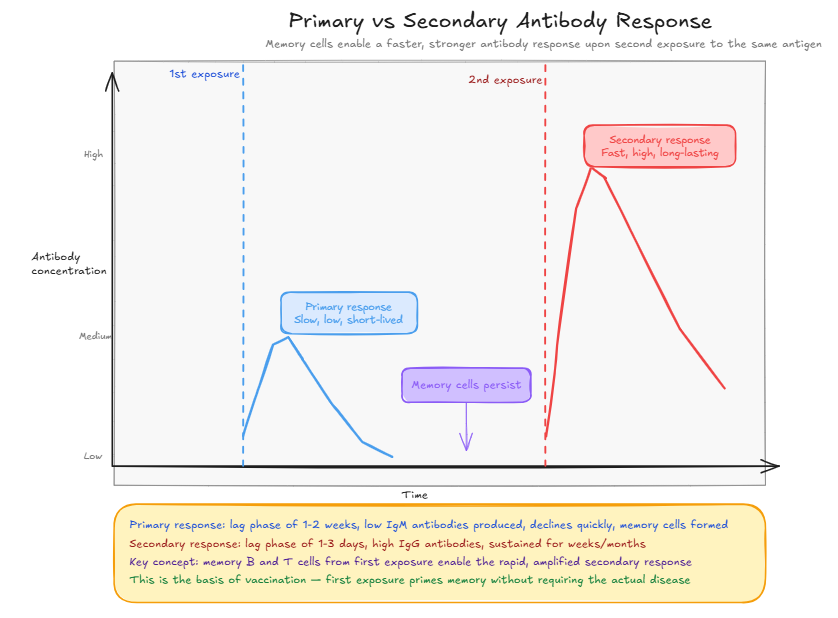
Primary vs Secondary Antibody Response Graph

Vaccination triggers a primary response and memory formation, if the real pathogen arrives later, the secondary response clears it before symptoms develop
| Feature | Primary Response | Secondary Response |
|---|---|---|
| Trigger | First exposure (infection or vaccination) | Re-exposure to same antigen |
| Lag period | 7–14 days to peak | 1–3 days to peak |
| Antibody peak | Relatively low | 10–100× higher |
| Antibody class | IgM first, then IgG | Mainly high-affinity IgG |
| Duration | Weeks | Months to years |
| Memory formed? | Yes, memory B and T cells produced | Yes, memory pool reinforced |
| Outcome | Person often becomes ill before response peaks | Usually cleared before symptoms develop |
Primary response: 7–14 day lag, low antibody level, IgM first then IgG, the person often becomes ill. Secondary response: 1–3 day lag, 10–100× higher antibody, mainly high-affinity IgG, usually cleared before symptoms. Both form/reinforce memory B and T cells; the entire difference is due to pre-existing memory cells.
Pause, copy the primary vs secondary comparison (lag, antibody level, class, outcome) into your book.
The secondary immune response has a longer lag period than the primary response.
Memory B and T cells persist after the primary response and enable a faster, stronger secondary response upon re-exposure.
The primary immune response produces a higher concentration of antibodies than the secondary immune response.
Engineering a safe first exposure
See how each vaccine type triggers memory without the disease, then extend it to boosters and herd immunity.
Antigen exposure without the disease, plus boosters and herd immunity
We just saw that a secondary response clears a pathogen fast because memory already exists. That raises a question: how can we build that memory safely, before the real pathogen ever arrives? This card answers it → vaccination, vaccine types, boosters, and herd immunity.
A vaccine introduces antigens in a form that cannot cause the full disease, so the immune system forms memory cells without the person suffering significant illness.
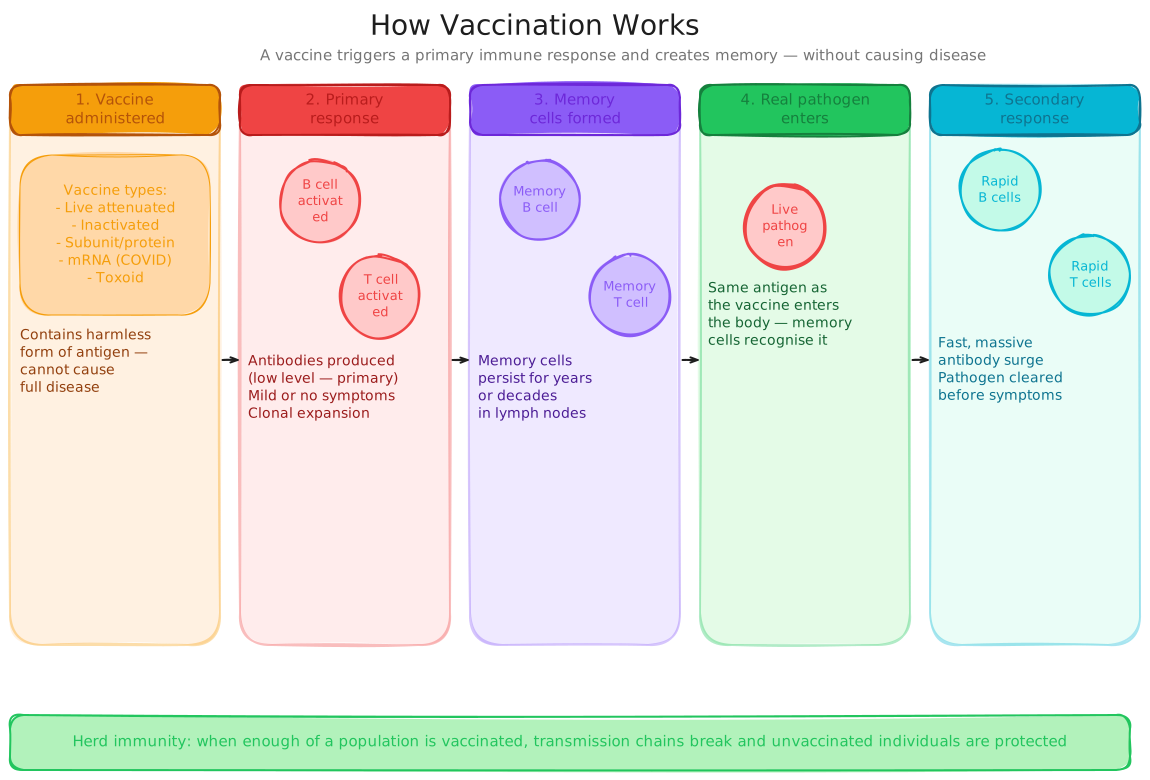
How Vaccination Works
When the real pathogen arrives later, the secondary response is already primed.

All vaccine types work by the same principle: trigger a primary response and memory formation without causing the full disease
Why Some Vaccines Need Boosters
Memory B and T cell populations decline over time if not reinforced by re-exposure. A booster dose acts as a second exposure, triggering a secondary response that elevates antibody levels and expands the memory cell population. Vaccines requiring boosters include tetanus (every 10 years), influenza (annually, because the virus mutates), and some childhood vaccines like diphtheria-tetanus-pertussis (DTP) which are given in a series to build adequate memory.
Herd Immunity
When enough individuals in a population are immune (through vaccination or prior infection), transmission chains break, even unvaccinated individuals are protected because the pathogen cannot find enough susceptible hosts to spread effectively. The threshold varies by pathogen: measles requires ~95% immunity; polio ~80–85%; COVID-19 varied with variant. Herd immunity is critical for protecting those who cannot be vaccinated, newborns, immunocompromised individuals, and those with vaccine contraindications.
A vaccine gives antigen exposure without the full disease → triggers a primary response and forms memory cells. Types: live attenuated, inactivated (killed), subunit/protein, and mRNA, all build the same immune memory. Boosters re-trigger a secondary response when memory fades (tetanus, flu, DTP series). Herd immunity: when a high % are immune, transmission chains break, protecting those who can't be vaccinated.
Pause, copy how vaccines work, the four vaccine types, boosters and herd immunity into your book.
Population-level protection that occurs when enough individuals are immune to break transmission chains is called _____ immunity.
Apply vaccination and memory
Trace vaccination from Jenner to eradication, fix misconceptions, then collect the response model.
Edward Jenner's 1796 experiment was contested, ridiculed, and eventually vindicated on a global scale. The mechanism he accidentally exploited, cross-reactive immunological memory between cowpox and smallpox antigens, worked because the two viruses share enough antigenic similarity that memory B and T cells raised against cowpox antigens also recognise and respond rapidly to smallpox antigens.
You will apply memory cell and vaccination concepts in the practice questions.
Primary Response
- First exposure to antigen (infection or vaccine).
- 7–14 day lag to peak; low antibody level; mainly IgM.
- Memory B and T cells formed.
- Person may become ill before response peaks.
Secondary Response
- Re-exposure to same antigen.
- 1–3 day lag to peak; 10–100× higher antibody; mainly IgG.
- Memory B cells rapidly → plasma cells.
- Usually cleared before symptoms develop.
How Vaccination Works
- Antigen introduced without causing full disease.
- Primary response triggered → memory cells formed.
- Real pathogen later → secondary response → cleared rapidly.
- Boosters reinforce memory when it fades.
Jenner's Key Insight
- Cowpox (mild) and smallpox share antigens.
- Cowpox exposure → primary response + memory cells.
- Smallpox exposure → secondary response (cross-reactive memory) → no disease.
- Smallpox eradicated 1980, entirely through vaccination.

Primary vs Secondary Immune Response
Practise independently
Attempt at least one response in your own words. Model answers support checking; they do not replace the attempt.
A fresh set drawn from this lesson's question bank, feedback shown immediately. +5 XP per correct · +25 XP all correct
Pick your answer, then rate your confidence, that tells the system what to drill next.
UnderstandBand 3(3 marks) 1. Describe what happens at the cellular level during the primary immune response to a vaccine. In your answer, identify the cells involved and explain what two populations are produced at the end of the response.
1 mark: antigen presented → clonal selection + T helper · 1 mark: clonal expansion → plasma cells · 1 mark: memory B and T cells formed
UnderstandBand 4(3 marks) 2. Compare the primary and secondary immune responses, referring to lag period, antibody level, antibody class, and outcome for the individual.
1 mark: lag period (7–14 vs 1–3 days) · 1 mark: antibody level and class · 1 mark: outcome
EvaluateBand 5(4 marks) 3. Explain how Edward Jenner's cowpox vaccination produced protection against smallpox in James Phipps. In your answer, refer to clonal selection, memory B cells, and the secondary immune response. Also explain why this approach eventually led to the global eradication of smallpox.
1 mark: cowpox → primary response → clonal selection · 1 mark: memory cells that also recognise smallpox (antigenic similarity) · 1 mark: smallpox challenge → secondary response clears virus · 1 mark: global vaccination → herd immunity → eradication
Show all answers
Multiple choice
MC answers and full explanations are shown inline as you complete each question. Use the retry button to attempt a fresh set from the lesson bank.
Short Answer Model Answers
Q1 (3 marks): When a vaccine antigen enters the body, dendritic cells engulf it and present antigen fragments on MHC class II molecules, migrating to lymph nodes. The antigen is encountered by the pool of naive B cells, each with a unique BCR. Through clonal selection, the specific B cell whose BCR matches the antigen binds it and receives a co-stimulatory signal from a T helper cell. This activated B cell undergoes clonal expansion, dividing rapidly to produce two distinct populations: plasma cells, short-lived antibody factories that secrete specific antibodies (initially IgM, then class-switched to IgG), and memory B cells, which are long-lived and persist for years to decades. Memory T cells are also formed. It is these memory cells, not the antibodies, that provide the lasting foundation for protective immunity.
Q2 (3 marks): The primary response has a lag period of 7–14 days to peak antibody production, reflecting the time for naive B cell clonal selection, expansion, and plasma cell differentiation. It produces initially IgM (lower affinity) then IgG, at a relatively low peak, the person typically becomes symptomatic before the response peaks. The secondary response has a lag period of only 1–3 days, because memory B cells are already clonally selected and present in large numbers, so they immediately differentiate into plasma cells. It produces predominantly high-affinity IgG at levels 10–100 times higher than the primary peak, maintained for longer. The outcome differs: in the secondary response, the infection is usually cleared before antibody levels reach a threshold that causes significant symptoms, the person is effectively protected.
Q3 (4 marks): When James Phipps was inoculated with cowpox, his immune system mounted a primary response: dendritic cells presented cowpox antigens in lymph nodes, the B cell clones with matching BCRs underwent clonal selection (with T helper co-stimulation) and expanded into plasma cells (clearing the mild cowpox infection) and memory B and T cells, which persisted. The key was antigenic similarity: cowpox (vaccinia) and smallpox (variola) share multiple surface antigens, so the memory cells raised against cowpox also recognised smallpox antigens. Six weeks later, when Jenner exposed Phipps to smallpox, his memory B cells were rapidly activated within hours, differentiating into plasma cells that flooded the bloodstream with high-affinity IgG within 1–3 days, neutralising and clearing the smallpox virus before it could replicate to disease-causing levels, so Phipps showed no symptoms. When this approach was scaled globally (the WHO campaign from 1967), increasing vaccination coverage progressively reduced the pool of susceptible individuals; transmission chains broke as the virus could not find enough susceptible hosts. The last natural case occurred in 1977; smallpox was declared eradicated in 1980, the only human infectious disease ever eradicated.
Retrieve and reflect
Use the Review session first, then compare how your thinking changed.
A full module quiz covering every lesson in this module, not just this one. Set aside a decent block of time and treat it like a real assessment.
Start the module quiz →Defend your ship by blasting the correct answers for Primary and Secondary Immune Response. Scores count toward the Asteroid Blaster leaderboard.
☄️ Play Asteroid Blaster →You were asked why the cowpox exposure protected James Phipps against smallpox, and what was happening in his immune system during the six weeks between exposures.
The mechanism: during those six weeks, Phipps's immune system was mounting a primary response to cowpox antigens, clonal selection of matching B cells, clonal expansion, plasma cell production (clearing the mild cowpox infection), and formation of memory B and T cells. The memory cells then persisted. When smallpox arrived, the cross-reactive memory cells recognised the shared antigens and mounted an immediate secondary response, before the virus could establish a significant infection.
If you predicted that "his immune system remembered the cowpox virus", essentially correct, though the memory is stored in specific long-lived lymphocytes, not as a general state of alertness. If you predicted "antibodies were already in the blood", partially right, but declining. The key is that even as antibody levels decline, the memory cell population persists and can rapidly regenerate antibodies on demand. If you did not predict the cross-reactivity between cowpox and smallpox, that is the crucial piece of biology Jenner observed empirically without understanding the mechanism.